Simulation
MUTANT Toolbox for Transmission Simulation
Overview of the MUTANT (Multibody Transient Analysis of Transmissions) toolbox developed at KU Leuven LMSD — a multi-fidelity framework for gear, bearing and drivetrain simulation that balances first-principles accuracy with the computational speed needed for practical engineering use.
Links & Resources
What MUTANT Is
MUTANT stands for Multibody Transient Analysis of Transmissions. It is a research-grade toolbox for dynamic simulation of geared transmissions, bearings and drivetrain systems at KU Leuven's Mecha(tro)nic System Dynamics (LMSD) research group. It began as the author's in-house code for dynamic gear contact analysis during his PhD, and has since been developed further by PhD researchers at LMSD, largely under his supervision — growing into a broader transmission modelling environment capable of addressing a wide range of NVH, durability and efficiency questions.
The central engineering question MUTANT was built to answer: how much physics does a simulation need to retain before it becomes predictive — and how much can be removed before it becomes fast enough to use?
The Problem MUTANT Solves
Dynamic gear contact simulation with full finite element fidelity is expensive. FE models introduce many degrees of freedom. Moving contact zones require small time steps. Nonlinear contact force evaluation scales with mesh density. A brute-force approach produces a progress bar that no engineer wants to watch.
MUTANT addresses this by offering multiple modelling layers, each appropriate for different questions.
At component level, reduced-order FE models of gears and bearings retain only the deformation patterns relevant to contact, transmission error and stress recovery — typically eigenmodes supplemented by interpolated contact shapes. The contact shapes capture the localized tooth deformation under moving gear loads without requiring the full FE mesh at every time step. The result is component-level models with orders-of-magnitude fewer degrees of freedom than their FE originals, at comparable accuracy for the quantities of interest.
At subsystem level, hybrid approaches split deformation into global and local components. The global deformation is captured by a reduced FE or analytical flexibility model; the local contact compliance follows from Hertzian or semi-analytical contact theory. This is often the right compromise between FE accuracy and lumped-parameter simplicity.
At system level, MUTANT feeds advanced gear and bearing descriptions into lumped-parameter drivetrain models, enabling study of gear whine, gear rattle, bearing reaction forces, shaft misalignment and transmission error under realistic operating conditions.
In This Portfolio
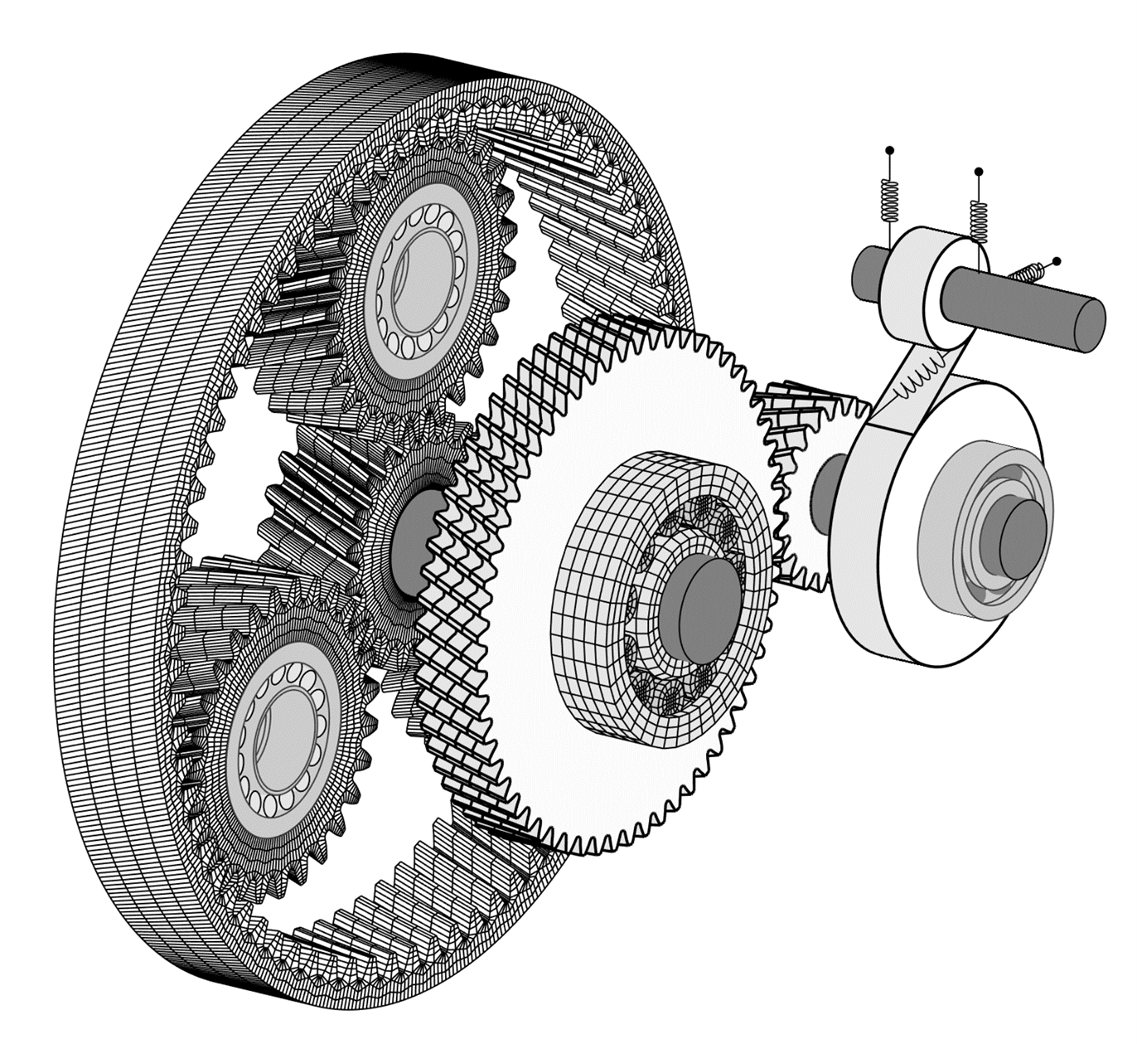
Several simulations on this site build directly on MUTANT: the McLaren MP4/4 gearbox fatigue analysis, the planetary gear wind turbine model with six simultaneous gear meshes, the EV bearing-creep simulation, and the Porsche 6-stroke engine drivetrain. The example below shows MUTANT applied to a multi-stage transmission, resolving simultaneous gear contact, shaft flexibility and dynamic transmission error.
Philosophy
MUTANT comes from the school of thought that says: before replacing the physics with a surrogate, first make the physics smart enough to be fast. Surrogate modelling has its place — particularly in outer-loop optimization where thousands of evaluations are needed — but the reduced-order models inside MUTANT remain physics-based throughout. They exploit geometry, periodicity, contact mechanics and structural dynamics to eliminate only what can safely be removed.
That distinction matters when the goal is not just prediction but understanding: knowing why a gear fails, what drives the noise, or where the efficiency is lost.
Related work