Simulation
Multi-physics Wind Turbine Drivetrain Simulation
Coupled time-domain simulation framework for a multi-megawatt wind turbine drivetrain, connecting flexible multibody rotor and planetary gearbox models with aerodynamic loading, doubly-fed induction generator dynamics and control logic to study how transient events — wind gusts, voltage dips and emergency braking — propagate into local gear mesh and bearing loads.
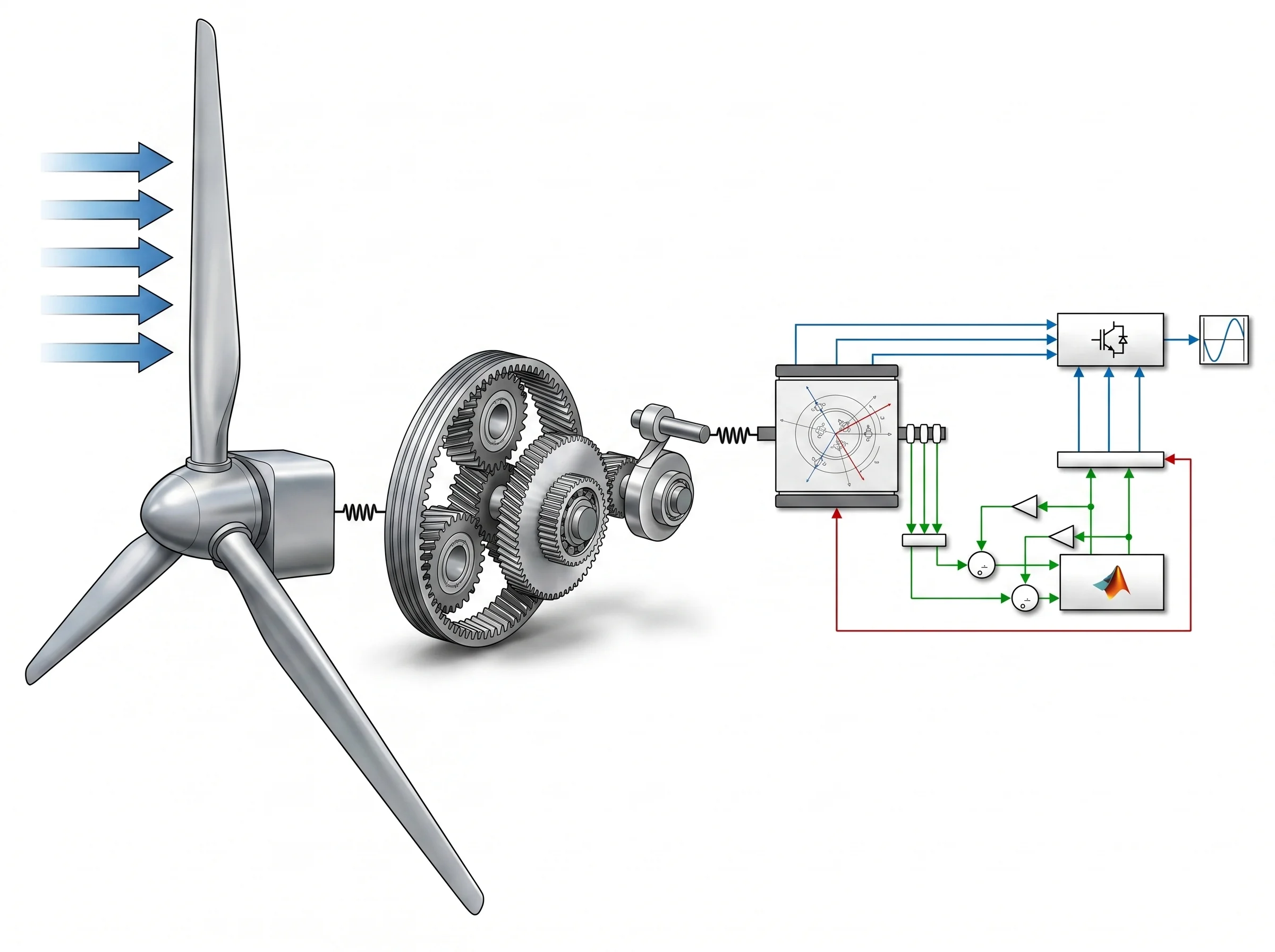
The Problem
Wind turbine drivetrain failures are among the most costly maintenance events in wind energy. Many of the most damaging loads arise not during steady operation, but during short transient events: wind gusts, turbulent inflow, voltage dips, grid loss, emergency braking, blade pitching or generator protection actions. Each of these enters the system through a different physical domain — aerodynamics, electrical grid or control — but ultimately propagates to the same mechanical system: rotor, shafts, gears and bearings.
Studying these load paths requires a simulation model that does not treat the gearbox in isolation. It requires one that captures the full chain from disturbance source to mechanical response.
The Simulation Framework
A coupled time-domain framework was developed at KU Leuven LMSD to study transient load events in a multi-megawatt wind turbine drivetrain. Four physical subsystems are connected:
- Flexible multibody rotor: the blades are modelled using Timoshenko beam elements, with aerodynamic forces computed from blade-element and vortex-based methods.
- Three-stage planetary gearbox: modelled in detail including flexible components, gear contact forces, bearing loads and the structural dynamics of the drivetrain.
- Doubly-fed induction generator (DFIG): a dynamic lumped-parameter model, including variable air-gap effects caused by bearing deformation under load.
- Controller model: coupled to the generator model, capturing the response of the power electronics and pitch control during transient events.
Numerical Challenge: Multiple Time Scales
The coupled system spans time scales from slow rotor revolutions to gear-mesh excitation and fast electrical dynamics. Integrating the full model directly is computationally prohibitive for practical load case studies. Model-order reduction was therefore applied at two levels: at component level, reducing the flexible multibody representations of gearbox shafts, housings, carriers and rotor blades; and at system level, using multiphysical reduction techniques that reduce the complete coupled system while preserving energetic consistency between the mechanical and electrical domains.
What the Simulation Reveals
The framework makes it possible to trace a disturbance from its origin — a wind vortex, a grid voltage event or a control action — through the complete machine to its mechanical expression as a local gear mesh force or bearing load. These short transient load paths are the ones most likely to drive fatigue, misalignment and contact amplification in long-term operation.
Individually, each of the physical phenomena involved is already well-studied. The coupling is where the difficulty lies — and where the most relevant engineering insight is found.
Related work