Simulation
PowerShift Hub Efficiency Analysis
Physics-based modelling and test-rig validation of the Classified PowerShift hub's mechanical efficiency, showing that a well-designed two-speed planetary drivetrain can match conventional high-end bicycle drivetrains while enabling performance gains further up the drivetrain.
Links & Resources
The Design
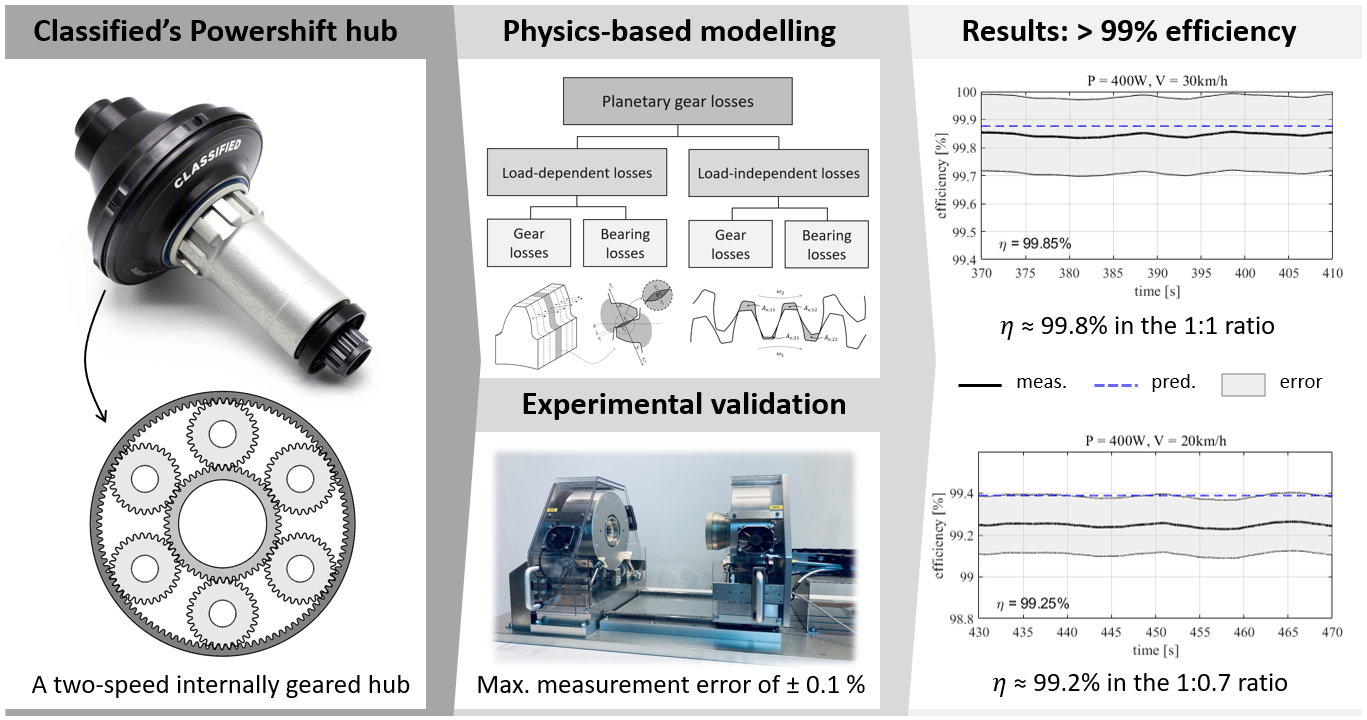
The Classified PowerShift hub replaces the front derailleur with a compact two-speed planetary gear system integrated into the rear hub. In its direct 1:1 ratio, the planetary stage rotates as a locked unit with no relative gear motion inside the hub. In the reduced 0.686 ratio, the sun gear is held fixed and six planet gears transfer torque between the cassette and wheel — producing a jump equivalent to moving from a 52-tooth to a 36-tooth chainring, without changing the external chainring or chainline.
Integrating the gear change into the hub raises a direct engineering question: how much mechanical efficiency, if any, does the added planetary stage cost?
Modelling and Validation
A detailed physics-based efficiency model was applied to the PowerShift hub, drawing on more than a decade of gear and bearing research at KU Leuven LMSD. The model accounts for gear mesh friction, bearing losses, seal drag and lubrication effects across the operating range of loads and speeds.
The model predictions were validated against a purpose-built test rig with controlled load and speed conditions. The two were in close agreement, with the hub achieving efficiencies exceeding 99% across the majority of its operating range — particularly strong in high-power, low-speed conditions characteristic of steep climbing, which is precisely when the reduced gear ratio is most likely to be engaged.
Upstream Benefits
High hub efficiency is part of a larger story. A 1x drivetrain with no front derailleur enables a constant, optimized chainline. Smaller effective chainring sizes at the bottom bracket reduce chain articulation angles and friction in the chain-sprocket interface. Bottom bracket forces are also reduced. The combination of these upstream effects makes the Classified drivetrain one of the most efficient bicycle drivetrain configurations measurable in controlled test conditions.
The full technical details are available in the public white paper referenced on this page.
Related work