Simulation
Human Power Across Sports
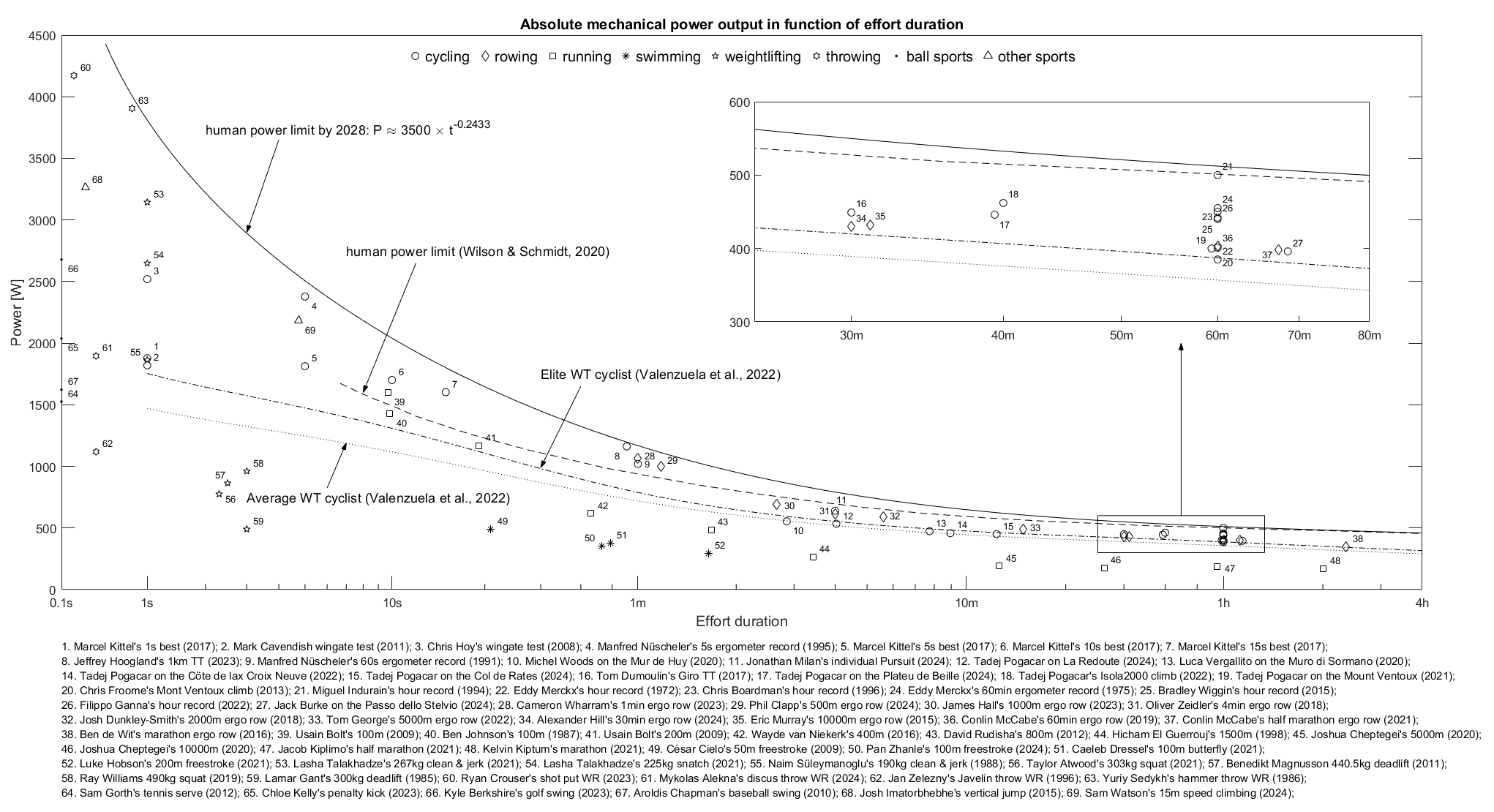
Back-of-envelope power calculations across competitive sports from sprinting to weightlifting, assembled into a power-versus-duration graph that quantifies where human performance boundaries are being set and where records are most likely to fall next.
Links & Resources
The Question
Who produces more power: a Tour de France sprinter or an Olympic weightlifter? The question is ill-posed until duration is fixed. Peak power in a clean and jerk may exceed anything a sprinter puts through the pedals, but the weightlifter's burst lasts a fraction of a second, while the cyclist sustains a smaller figure for minutes. The comparison only becomes meaningful when power is plotted against the duration over which it is held — which is what this analysis sets out to do.
The Data
These calculations collect publicly available performance data from cycling, weightlifting, running, swimming, rowing, speed climbing and track athletics, and convert each to mechanical power output using basic kinematic and force analysis.
Biomechanical inefficiencies are not corrected for: limb swing during running, non-tangential pedalling forces, and similar effects mean the actual mechanical output is higher than the figures shown, particularly for sports with less efficient movement patterns. Human metabolic efficiency is approximately 20–25%, comparable to an internal combustion engine, so metabolic power is approximately 4 to 5 times higher than the mechanical values displayed.
Cycling as a Reference
Among all human-powered locomotion activities, cycling is mechanically the most efficient biomechanically and the most effective form of human-powered transport. Watts per kilogram on a bicycle in urban conditions substantially exceeds the equivalent figure for a passenger car. This is not a controversial statement — it follows directly from the physics of rolling resistance, aerodynamic drag and gearing efficiency.
Records and Trends
Historical performance records show a consistent pattern: once a limit is defined, it tends to be revised. The graph includes reference curves for estimated human power limits, several of which have already been surpassed in the period since they were published. With data-driven training methods continuing to develop, the rate of record-setting is expected to accelerate rather than slow over the next decade.
Speed climber Sam Watson's recent performance already moved beyond the estimated relative human power limit curve used in this analysis — a useful reminder that any upper bound on human performance deserves a question mark.