Simulation
Bodyweight and Cycling Performance
First-principles analysis of where extra bodyweight helps and where it hurts cycling performance, deriving the gradient-duration boundary that separates power-favoring from power-to-weight-favoring terrain from first principles.
Links & Resources
The Question
At what combination of gradient and effort duration does a heavier, more powerful cyclist outperform a lighter, less powerful one — and where does that advantage reverse? The intuition captured in "watts per kilogram" is well understood for long climbs. The conditions under which "mass equals power" holds for flatter or shorter efforts is less often quantified.
First-Principles Model
The maximum velocity a rider can sustain on a road of gradient G during an effort of duration t is determined by the balance between required and available power. Required power is the sum of aerodynamic and gravitational resistive components. Aerodynamic drag scales with the rider's frontal area, which literature shows scales with body mass raised to approximately the 1/3 power. Gravitational resistance is directly proportional to mass and gradient.
Available power — the maximum power a cyclist can sustain for a given duration — scales with body mass raised to a power between 2/3 and 3/4, with larger exponents corresponding to shorter, more explosive efforts. This scaling is consistent across both athlete and animal power data.
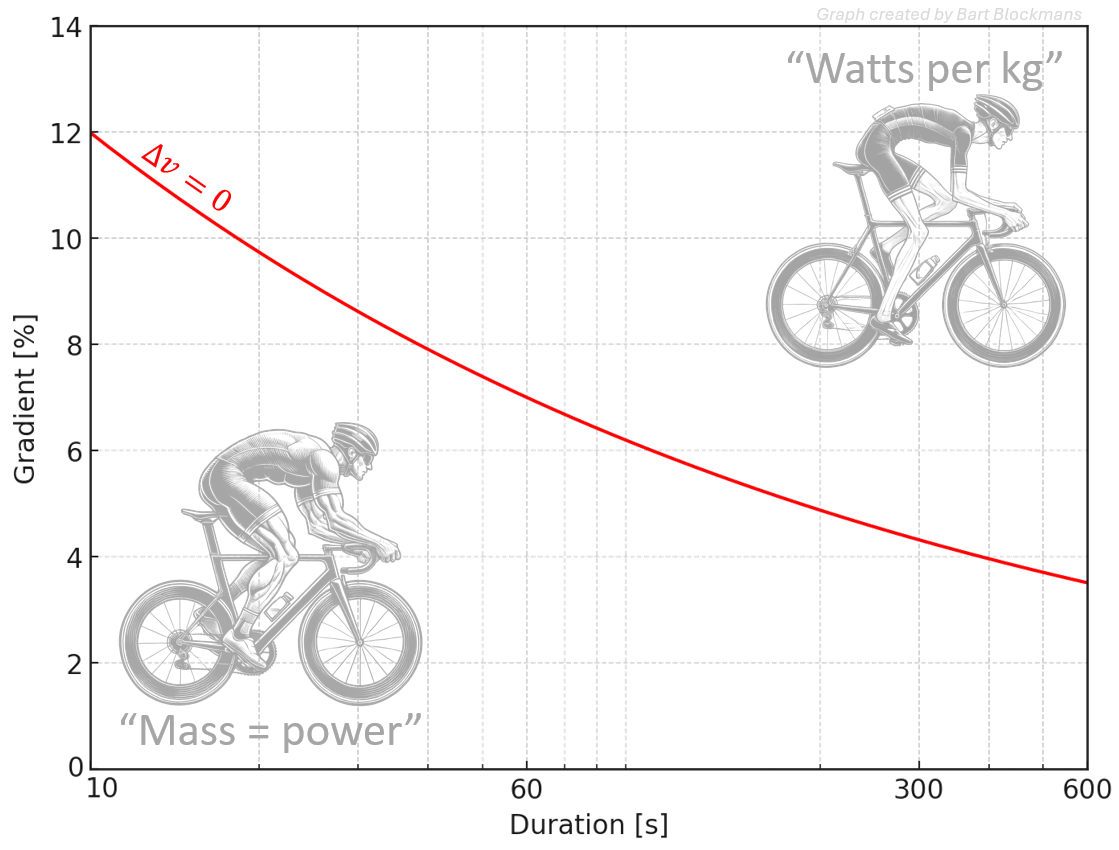
Setting required equal to available power and solving for the body-mass exponent in the resulting velocity expression yields the gradient-duration combinations where that exponent is exactly zero: the boundary where bodyweight has no effect on velocity. Below this boundary in gradient-duration space, heavier cyclists are faster; above it, lighter cyclists are faster.
Main Result
The boundary where bodyweight has no net effect on velocity falls at a steeper gradient for shorter efforts and a gentler one for longer efforts. Reading the zero-effect line off the analysis, it crosses roughly 12% gradient for 10-second efforts, 10% for 20 seconds, 7% for one minute, 6% for 100 seconds and 4% for 300 seconds. Below these gradient-duration combinations a heavier, more powerful rider is faster; above them the lighter rider wins. The shorter and flatter the effort, the more raw power and mass pay off; the longer and steeper it becomes, the more it turns into a contest of power-to-weight.
The Mont Ventoux, at approximately 8% average gradient and 20 km distance, sits clearly above the boundary for most rider types — a substantial advantage to lighter athletes. Belgian climbs, typically steeper but shorter than 10 minutes for a well-trained rider, cluster near and below the boundary. On those climbs, fitness rather than bodyweight is the primary performance determinant.
A third data point: the analysis of Wout van Aert's stage win on Ventoux — nearly 10 kg heavier than that year's race winner — illustrates that extreme fitness advantage can overcome an unfavorable position relative to the boundary, but not without leaving physiological marks elsewhere in the race.
Related work