Simulation
Wind and Elevation Effects on Cycling Speed
First-principles analysis of how headwind and hilly terrain reduce a cyclist's average speed on a loop, showing that optimal pacing reduces the penalty but cannot eliminate it, with the penalty factor scaling with wind speed squared and average gradient squared respectively.
Links & Resources
The Intuition Problem
Any cyclist who has ridden a loop on a windy day knows the feeling: the tailwind back never seems to compensate for the headwind out. This is not bad luck — it is a physical consequence of how aerodynamic drag scales with relative velocity, and it can be quantified precisely from first principles.
Wind Effects
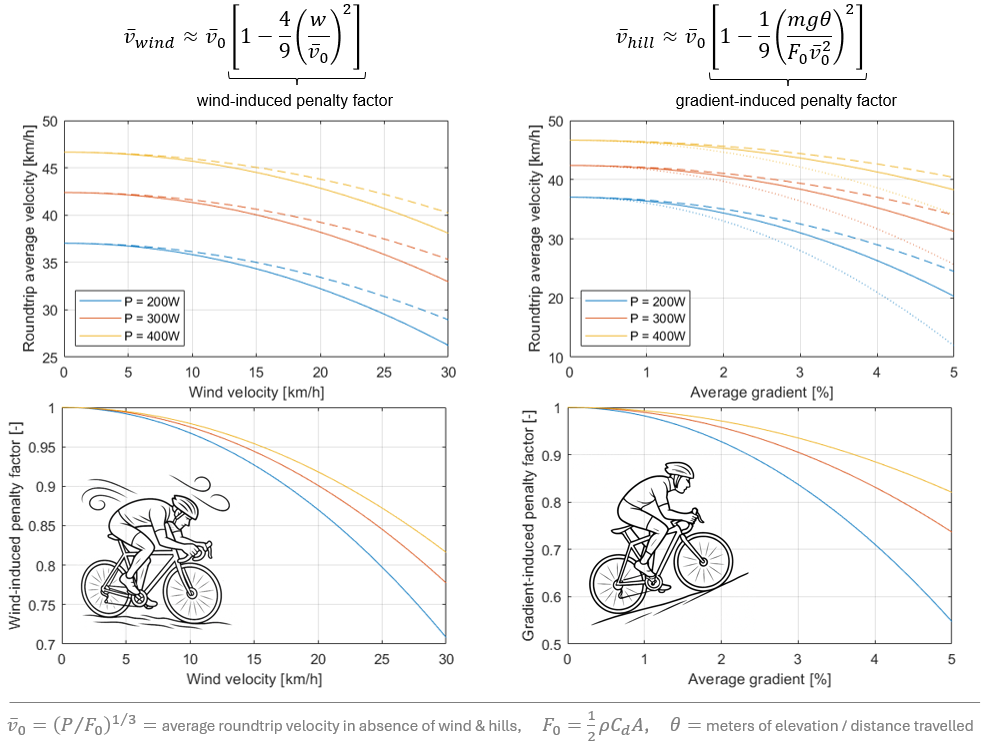
At constant power, a simplified drag model gives a clean result: a cyclist's speed decreases or increases by approximately two thirds of the wind speed when riding directly into or with the wind. At 300 W required to sustain 40 km/h on a calm day, a 12 km/h headwind reduces that to 32 km/h; the matching tailwind raises it to 48 km/h.
These speeds are not symmetric in time. More time is spent in the headwind section than the tailwind section on the same route, so the true average velocity is reduced. The penalty factor scales with the square of the wind speed relative to the rider's calm-weather speed. Optimal pacing — working harder into the wind and easing off with the wind — reduces this penalty but cannot bring it to zero.
Elevation Effects
The same analysis applies to hilly terrain. The average velocity on a loop with net-zero elevation is reduced relative to flat terrain, with the penalty scaling with the square of the average gradient. The penalty is moderate under constant-power assumptions, which surprises many cyclists who expect the climb to cost far more than the descent recovers.
The analysis changes when a terminal velocity constraint is introduced. Most cyclists cannot maintain high cadence on steep descents, and a 50 km/h terminal velocity assumption makes the gradient-induced penalty considerably larger. This effect is shown explicitly in the figures.
What the Equations Tell You
The outcome of the analysis is a pair of simple scaling laws. At equal power, the average-speed penalty grows with the square of the wind speed relative to the rider's calm-weather speed, and with the square of the average gradient. Both penalties are strictly negative: wind and hills always reduce average speed on a loop, because the headwind and the climb cost more than the tailwind and the descent return. Optimal pacing — pushing harder into the wind and on the climb — softens the loss but can never bring it to zero. The value of the result is that it is quantitative: given the expected wind and the elevation profile of a route, a rider can estimate the speed penalty before setting out and adjust expectations accordingly, and a time-triallist can justify the pacing strategy that minimizes it.
Related work