Simulation
Mercator Telescope Mirror FEA
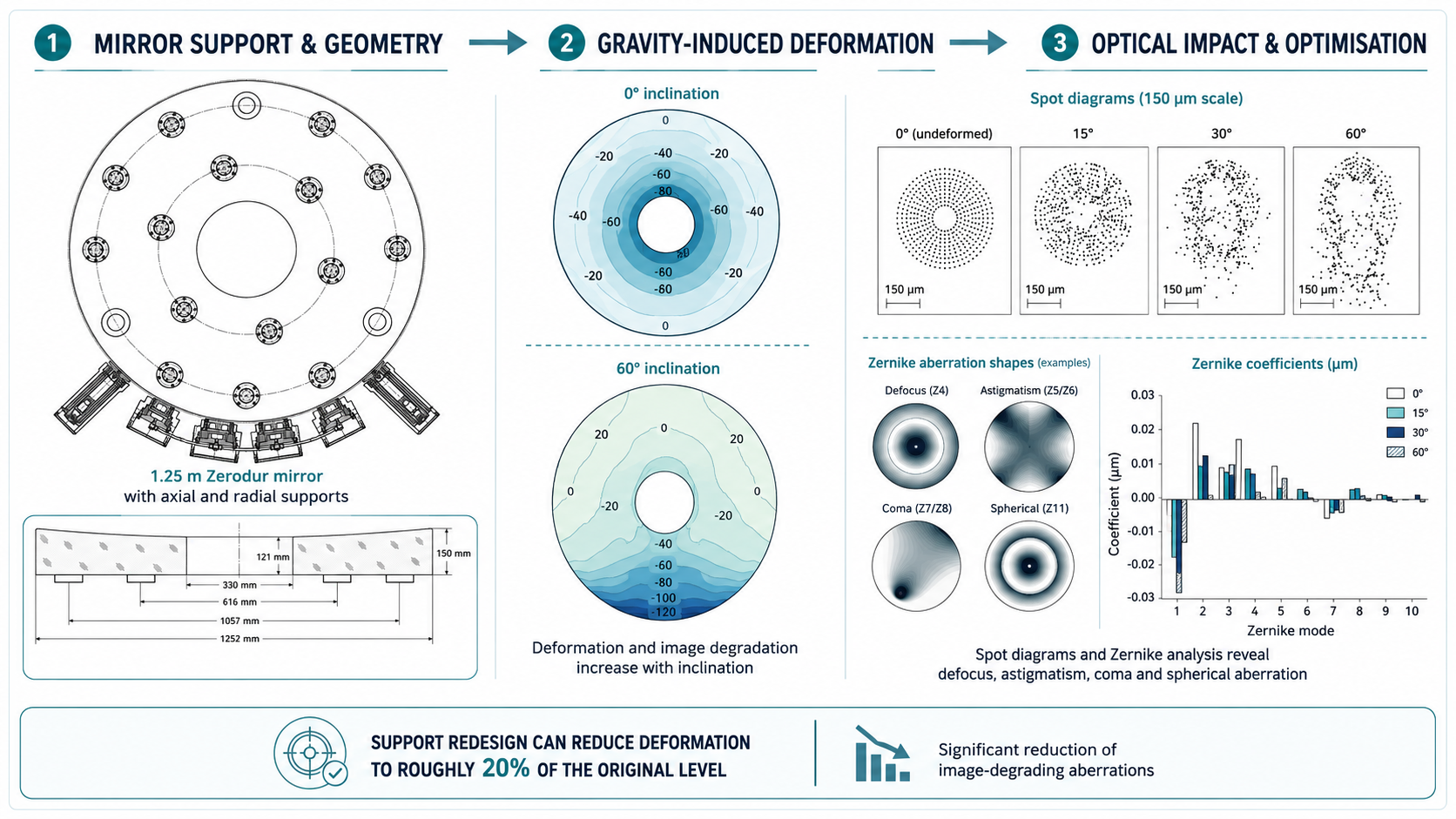
Finite element analysis of the 1.2 m Zerodur primary mirror of the Mercator telescope on La Palma, translating gravitational deformations at different inclination angles into optical aberrations using Zernike polynomials to assess image quality.
The System
The Mercator telescope is a 1.2 m Ritchey-Chrétien telescope operated by KU Leuven on La Palma in the Canary Islands. Its primary mirror is machined from Zerodur, a glass-ceramic material chosen for its near-zero thermal expansion coefficient. The mirror weighs approximately 400 kg and is supported by a combination of axial and radial support points.
As the telescope changes inclination to track a celestial object, the direction of gravitational loading relative to the mirror surface changes. The resulting deformations — measured in nanometres — can still be large enough to degrade image quality in a precision optical instrument.
Analysis
The work combined three components. Analytical mirror-support theory provided the basic framework for understanding which deformation modes are driven by the support geometry. A finite element model predicted the gravitational deformation field across the mirror surface at multiple inclination angles, capturing both the axial bending and radial deformation components.
The critical step was translating structural deformation into optical performance. Zernike polynomial decomposition breaks the deformed mirror surface into its constituent aberration terms — defocus, astigmatism, coma, spherical aberration and higher-order terms. This connects the structural mechanics output to the image-plane quality metrics that determine whether the telescope can meet its optical specifications.
Results
Image degradation increases with telescope inclination, primarily driven by astigmatism and coma introduced by the radial support system. By modifying the position and force distribution of the support points, the image-degrading aberration terms could be reduced significantly. The analysis showed which support point configurations provide the best compromise between mechanical stability and optical performance across the telescope's inclination range.
Significance
The value of this analysis lies at the interface between structural mechanics and optics. A contour plot of mirror deformation is interesting in its own right, but it only becomes meaningful once translated into what those deformations do to the light reaching the image plane. The governing threshold is therefore an unusual one: not the strain and stress limits that bound fatigue and durability in most structural dynamics problems, but nanometre-scale surface-figure error measured against an optical performance budget. A simulation becomes truly useful only when it is connected to the actual performance metric of the system being designed — here, image quality rather than mechanical integrity.