Simulation
Image-to-CdA Cyclist Aerodynamics
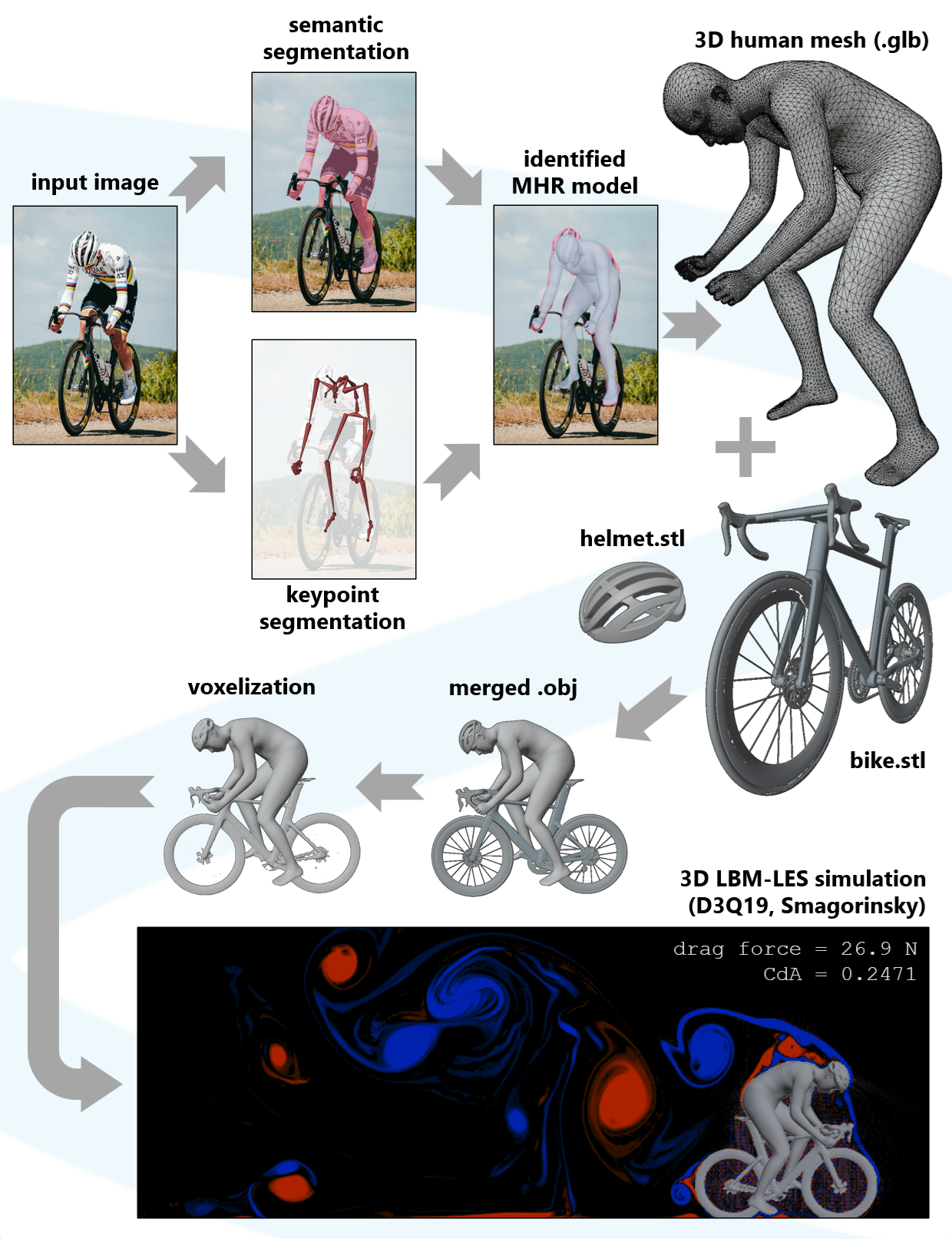
A pipeline that takes a single photograph of a cyclist and returns an aerodynamic drag estimate in under 10 minutes, combining AI-based 3D human reconstruction with GPU-accelerated Lattice Boltzmann CFD.
Links & Resources
The Problem
Measuring a cyclist's aerodynamic drag coefficient (CdA) traditionally requires a wind tunnel or an instrumented field test under controlled conditions. Both are expensive, time-consuming, and inaccessible to the vast majority of cyclists. The question is how much of that process can be replaced by a camera and a laptop.
The Pipeline
The approach combines two technically distinct components. The first is AI-based 3D human reconstruction. Meta's MHR human model is parameterized using 321 parameters: 72 for facial expressions (irrelevant here), 113 for body shape and skeleton dimensions, and 136 controlling dynamic pose. Tools like SAM 3D Body fuse semantic and keypoint segmentation with these physics-informed priors to resolve the otherwise ill-posed depth ambiguity of a single image. The reconstructed cyclist mesh is then augmented with CAD models for bicycle, helmet, glasses and shoes — objects that SAM 3D handles less well without the physics-based scaffolding of 3D human recovery.
The second component is a CFD solver based on the Lattice Boltzmann Method (LBM). Unlike conventional Navier-Stokes solvers, LBM approximates fluid flow through the streaming and collision of particle distributions. Its local, explicit formulation enables massive GPU parallelization — roughly two orders of magnitude faster than CPU-based equivalents — and eliminates the need for conformal surface meshing by immersing the reconstructed geometry in the solver via voxelization.
Timing
On an entry-level GPU, the full pipeline takes approximately 10 minutes from image to CdA: about 20 seconds for 3D reconstruction and voxelization, 2 minutes for transient wake development, and 8 minutes for time-averaging drag over five convective time scales. On a high-end GPU such as an NVIDIA RTX 5090, this could be brought to well under 2 minutes.
Extension Paths
Several refinements are technically straightforward. Using images from multiple viewpoints — front, left, and right — reduces the 3D reconstruction error by providing more constraints to the MHR parameter fitting. For clothing detail, methods like ECON can supplement or replace SAM 3D Body. For repeated measurements of the same athlete, offline body-shape calibration reduces online inference to pose estimation only across the 136 pose parameters.
More fundamentally, because all valid cycling poses occupy a low-dimensional manifold inside the 136-dimensional pose space, and because each CdA evaluation takes around 2 minutes, surrogate modelling becomes practical. That opens the door to real-time aerodynamic feedback during training: a reduced-order model fed by a camera acting as an aerodynamic sensor, closed by an AI-enhanced identification framework — the components of a genuine digital twin, with the remaining work lying in validation and deployment.